
Xtreme Download Manager
Free XDM Download for Windows,
Mac and Linux
Xtreme Download Manager, widely known as XDM, is a free, open-source download accelerator that replaces your browser’s built-in downloader with a faster and more capable engine. Whether you need to download large files, grab streaming videos, resume interrupted transfers, or schedule downloads for off-peak hours, XDM handles everything at no cost, with no ads, and with full support for Windows, macOS, and Linux. This complete guide covers everything you need to know about the xtreme download manager — how to download it, install it, connect it to your browser, and get the most out of it.
What is Xtreme Download Manager (XDM)?
Xtreme Download Manager is a cross-platform download manager developed as an open-source project hosted on GitHub. It was originally created by Subhra Das Gupta and has grown into one of the most widely used free download managers available today. Unlike browser-built-in downloaders that transfer a file as a single stream, XDM uses multi-segment parallel downloading technology to split every file into multiple chunks and download them simultaneously, dramatically increasing transfer speeds on most internet connections.
XDM is built in Java, which explains its cross-platform compatibility. The same codebase runs natively on Windows, Linux, and macOS without platform-specific rewrites. This is rare in the download manager space, where most competitors are Windows-exclusive. Because XDM is open source, its code is fully auditable by anyone — a significant trust advantage over closed-source commercial tools that disclose nothing about their internal behaviour.
The software integrates directly with Chrome, Firefox, Edge, and Opera via a lightweight browser extension. Once installed, every download link you click is automatically intercepted by XDM, which handles the transfer with its faster, multi-threaded engine. Video links from YouTube, Vimeo, Facebook, and thousands of other streaming platforms are detected and downloadable with a single click from within your browser.
XDM supports HTTP, HTTPS, FTP, and DASH protocols, giving it the versatility to handle virtually any file type or source. It includes a built-in scheduler so you can queue downloads to begin at specific times, which is ideal for downloading large files during off-peak hours when bandwidth is cheaper or faster. Resume support means that if your connection drops mid-download, XDM picks up exactly where it left off without starting over from the beginning.
XDM — A Powerful Open-Source Download Accelerator

Being open source is not merely a technical footnote for XDM — it is a foundational advantage that affects every dimension of the software. The full source code of the xdm download manager is publicly available on GitHub. This means that independent security researchers, developers, and privacy advocates can inspect every line of code to verify that XDM contains no hidden trackers, data collection routines, or malware. For users who are cautious about what software they install on their systems, this transparency is invaluable.
Closed-source download managers have no obligation to disclose what their software does in the background. XDM carries no such opacity. Every update is visible in the public changelog, every reported bug is tracked in the public issue tracker, and every contribution from the developer community is merged in the open. This creates an accountability structure that commercial software rarely achieves.
The GitHub repository for XDM has accumulated thousands of stars and active forks, a reliable indicator of community trust and ongoing development interest. When bugs are discovered, the open-source model allows the community to identify, report, and patch them far faster than a single proprietary team could manage. XDM also packages a bundled Java Runtime Environment in its installer.
How XDM Increases Download Speed Up to 500%

The speed advantage of xtreme download manager is the direct result of a fundamentally different approach to file transfers. Standard browser downloaders open a single connection to the server and pull the file from start to finish as one stream. If that connection runs at fifty percent of your available bandwidth, you use fifty percent and there is no mechanism to push harder or faster.
XDM solves this by splitting every download into multiple segments — typically eight to sixteen parallel chunks — and opening a separate connection for each simultaneously. Each connection saturates as much bandwidth as the server allows, so your total available speed is used far more efficiently. On most broadband and fibre connections, this alone can double or triple raw download speeds compared to any browser downloader.
The improvement is most pronounced when downloading from servers with per-connection rate limits, on high-latency connections where TCP slow-start restricts throughput, and for large file downloads where a single connection spends significant time at sub-optimal speeds. Users consistently report that xtreme download manager increase download speed results of three to five times are achievable on the same connection, with the best-case scenario reaching five hundred percent improvement on heavily throttled servers.
Key Features of Xtreme Download Manager
The xtreme download manager features span four major areas: download acceleration, media grabbing, transfer management, and media conversion. Every feature is available without any premium licence or subscription. The capabilities that generate the most user loyalty are download resumption and the scheduler that automates large download queues without supervision.
Resume Broken and Interrupted Downloads
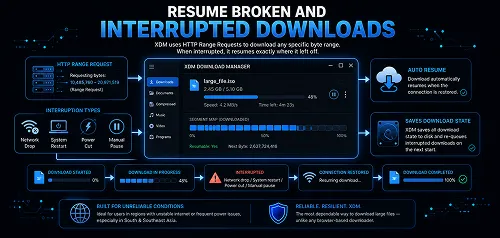
XDM’s resume broken downloads capability uses the HTTP Range request standard, which allows it to request any specific byte range of a file from a server rather than always starting from byte zero. When a download is interrupted — by a network drop, system restart, power cut, or manual pause — XDM stores the exact byte position of every downloaded segment and resumes from those positions when connectivity returns.
This works across all interruption types. When your network disconnects, XDM marks the download as paused and automatically resumes when the connection restores. When your system shuts down, XDM saves all download state to disk and re-queues interrupted downloads on the next start. For users in regions with unreliable power supply or intermittent connectivity — particularly in South and Southeast Asia, where XDM sees its largest audiences — this single feature alone justifies using XDM over any browser-based downloader available.
Download Streaming Videos from YouTube, Vimeo and More

The xdm video downloader works through browser-level monitoring. When the XDM extension detects streaming video content on the current page, it overlays a download button directly on the video player. Clicking it opens XDM’s quality selection dialog, where you choose the resolution and format before the download begins. The process takes seconds and requires no manual URL copying.
XDM supports video grabbing from YouTube at all available resolutions up to 4K, Vimeo, Facebook, Instagram, Dailymotion, Twitter, Reddit, and hundreds of regional platforms. For DASH streams — the adaptive format used by YouTube — XDM downloads the video and audio tracks separately and automatically merges them into a single complete output file. This merging is fully automatic and transparent; you simply receive a properly formatted video file when the download finishes.
Schedule and Queue Downloads Automatically
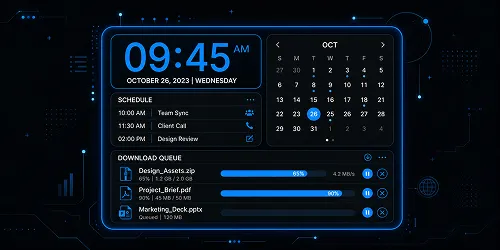
The schedule downloads XDM system operates at two levels. Per-download scheduling lets you set a specific start time for any individual file. Global scheduler settings let you define a download window — a range of hours during which XDM actively downloads — which is ideal for internet plans with off-peak unmetered data allowances.
The download queue supports drag-and-drop reordering so you can prioritise specific files over others. You configure maximum simultaneous downloads to balance parallel throughput against per-file speed. XDM’s optional shutdown-after-completion feature powers off your computer automatically when the last queued download finishes, saving electricity without requiring you to wait for the queue to clear.
XDM Browser Extension — Chrome, Firefox, Edge and Opera
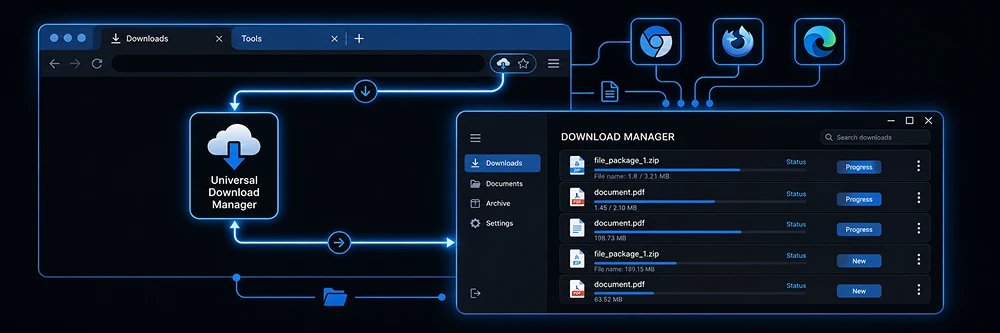
The xdm browser extension transforms XDM from a standalone manager into a seamless part of daily browsing. Once installed, it intercepts every download link you click and routes it through XDM’s multi-threaded engine. The extension communicates with the XDM desktop application via a local port connection, keeping its browser-side footprint near zero with no measurable impact on browsing speed.
How to Install XDM Extension on Google Chrome
Installing the XDM Chrome extension requires two things: XDM desktop must be running, and the extension must be installed from the Chrome Web Store. Open XDM and confirm it is running in your system tray. In Chrome, go to the Web Store, search for XDM Browser Monitor, and click Add to Chrome. Approve the permissions dialog to complete installation.
After installation, the XDM icon appears in your Chrome toolbar. Click it to verify a green Connected indicator. Test by clicking any download link — instead of Chrome’s native download bar, the XDM download dialog should appear, offering save location and scheduling options before the accelerated transfer begins.
How to Install XDM Extension on Firefox
Installing the xdm firefox extension follows the same two-step process but uses Mozilla’s Add-ons portal rather than the Chrome Web Store. In Firefox, go to the Add-ons portal, search for XDM Browser Monitor, and click Add to Firefox. Approve the permissions and verify the Connected status in the extension popup.
Firefox users on Linux may encounter a native messaging host error on initial connection. Open XDM, go to Tools, then Browser Integration, then Firefox, and click Register Native Messaging Host. This writes the required manifest to the correct system location and resolves the connection issue in the vast majority of cases without any further steps needed.
XDM vs IDM — Is Xtreme Download Manager Better
Than Internet Download Manager?
The xtreme download manager vs IDM comparison is one of the most frequently searched questions in the download manager category. Both tools are multi-segment download managers with full browser integration, but they differ in three critical areas: price, platform support, and open-source transparency. IDM costs approximately twenty-five dollars for a lifetime single-PC licence and is Windows-only. XDM is completely free and runs on Windows, Linux, and macOS. XDM additionally includes a built-in FFmpeg-powered media converter that IDM does not offer, and its video grabbing covers a broader range of streaming platforms.
| Feature / Capability | Xtreme Download Manager (XDM) | Internet Download Manager (IDM) |
|---|---|---|
| Price & License | 100% Free & Open Source (GPL v2) | $24.95 Paid License (Proprietary) |
| OS Support | ✓ Windows, macOS & Linux | ✕ Windows Only |
| Source Code Auditability | 100% Public Code on GitHub | Closed Proprietary Code |
| Multi-Segment Acceleration | Up to 32 Parallel Segments (500% speedup) | Up to 32 Parallel Segments |
| Video Grabbing & DASH Merging | YouTube 4K, Vimeo, FB, DASH + Auto Merge | Popular streaming sites |
| Built-in Media Converter | ✓ Yes (FFmpeg-powered conversion) | ✕ No (Requires third-party tools) |
| Adware & Telemetry | Zero Ads, Zero Trackers, Zero Telemetry | Ad-free paid app |
| Browser Integration | Chrome, Firefox, Edge, Opera, Brave | Chrome, Firefox, Edge, Opera |
Why XDM is the Best Free IDM Alternative
For users searching for the best free alternative to IDM, XDM is consistently the top recommendation across developer communities, tech forums, and independent review sites. The reason is feature parity — XDM covers the complete IDM feature set including multi-segment acceleration, full browser integration, download resume, scheduling, video grabbing, and queue management. No other free download manager matches this combination comprehensively.
User experience quality matters for daily use. XDM’s interface is clean, logical, and fast to navigate. Active development is equally important — XDM receives regular updates for Chrome, Firefox, and streaming site compatibility as their APIs evolve. For Linux and macOS users, XDM is not just the best free IDM alternative — it is the only serious option, since IDM does not support those platforms at all.
Xtreme Download Manager Troubleshooting
Common Problems and Fixes
The most common xtreme download manager not working issues fall into three categories: browser extension connectivity failures, video detection problems, and version compatibility issues following updates. Before any specific fix, always restart both XDM and your browser in the correct sequence: close the browser first, confirm XDM is running, then relaunch the browser. This resets the native messaging connection and resolves the majority of reported issues.
XDM Extension Not Working on Chrome or Firefox
When the xdm chrome extension not working issue occurs, it typically manifests as the Disconnected status in the extension popup or download links opening in the browser’s native downloader. Close Chrome completely, confirm XDM is running in the system tray, then relaunch Chrome. If still disconnected, open XDM, go to Tools, then Browser Integration, then Chrome, and click Re-register native messaging host. This resolves the connection in almost all cases without reinstalling anything.
How to Update Xtreme Download Manager to the Latest Version
Keeping XDM updated ensures browser extension compatibility, current streaming site support, and security. Open XDM, go to Help, then Check for Updates. If an update is available, XDM provides a direct download link to the new installer. On Windows, the new installer updates the application while preserving your settings and download history. Updates are most critical after major Chrome or Firefox version releases, as browser extension programming interfaces occasionally change between major versions and require a corresponding XDM extension update.